
How to find the right Bookkeeper for your Business
By Paolo, 09.02.2026

Choosing the right bookkeeper is more than just a business transaction; it’s a long-term investment. In many ways, it’s comparable to buying a family home or even nurturing a personal relationship. It requires trust, time, and shared values.
Since your bookkeeper is the person helping you manage your business’ financial lifeblood, the strength of that partnership is paramount. It’s not just about finding someone who understands your industry; it’s about finding someone whose ethics and values align with your own.
Too often, I heard from business owners rushed this process, hiring the first company that appears on a Google search.
After many years in the industry, five as an MYOB trainer and ten running my own firm, I’ve developed a clear sense of what makes a bookkeeper proficient and which red flags should send you running.
This post is a departure from my usual technical updates on compliance. It is a subjective view of my industry based on my personal experience. While some colleagues may disagree with some of my points, these are the lessons I’ve learned “in the trenches” about what truly makes a partnership between a bookkeeper and a business work.
Finding the Right Bookkeeper – all the questions from a Business Owner
What is the most important thing I should seek when engaging a bookkeeper?
Look for this symbol! 
When vetting a bookkeeper, the Tax Registration symbol is non-negotiable.
This isn’t just a badge; it’s your assurance that this is a professional accredited by the Tax Practitioners Board (TPB).
The registration confirms they have the formal qualifications and ongoing training required to provide legally binding services, including GST, BAS and payroll.
Furthermore, the TPB mandates that agents maintain professional indemnity insurance and commit to continuous professional education, ensuring their knowledge is up-to-date and your business stays protected.
Can a non-registered BAS/Tax Agent provide bookkeeping services?
The TPB provides a fairly vague definition of what non-registered bookkeepers can provide:
“Non‑registered bookkeepers can provide day‑to‑day bookkeeping and administrative services that do not involve interpreting or applying GST, PAYG, or other BAS provisions, and do not amount to BAS or tax agent services.”
Whilst a lot of non-registered bookkeepers love to find the grey areas in the TPB definition, my interpretation is simple and direct: if your business is registered for GST or has employees, you need a registered agent. Unregistered bookkeepers should only handle businesses that are not GST-registered and have no payroll obligations.
“When it comes to your business finances, shades of grey quickly turn into red flags!”

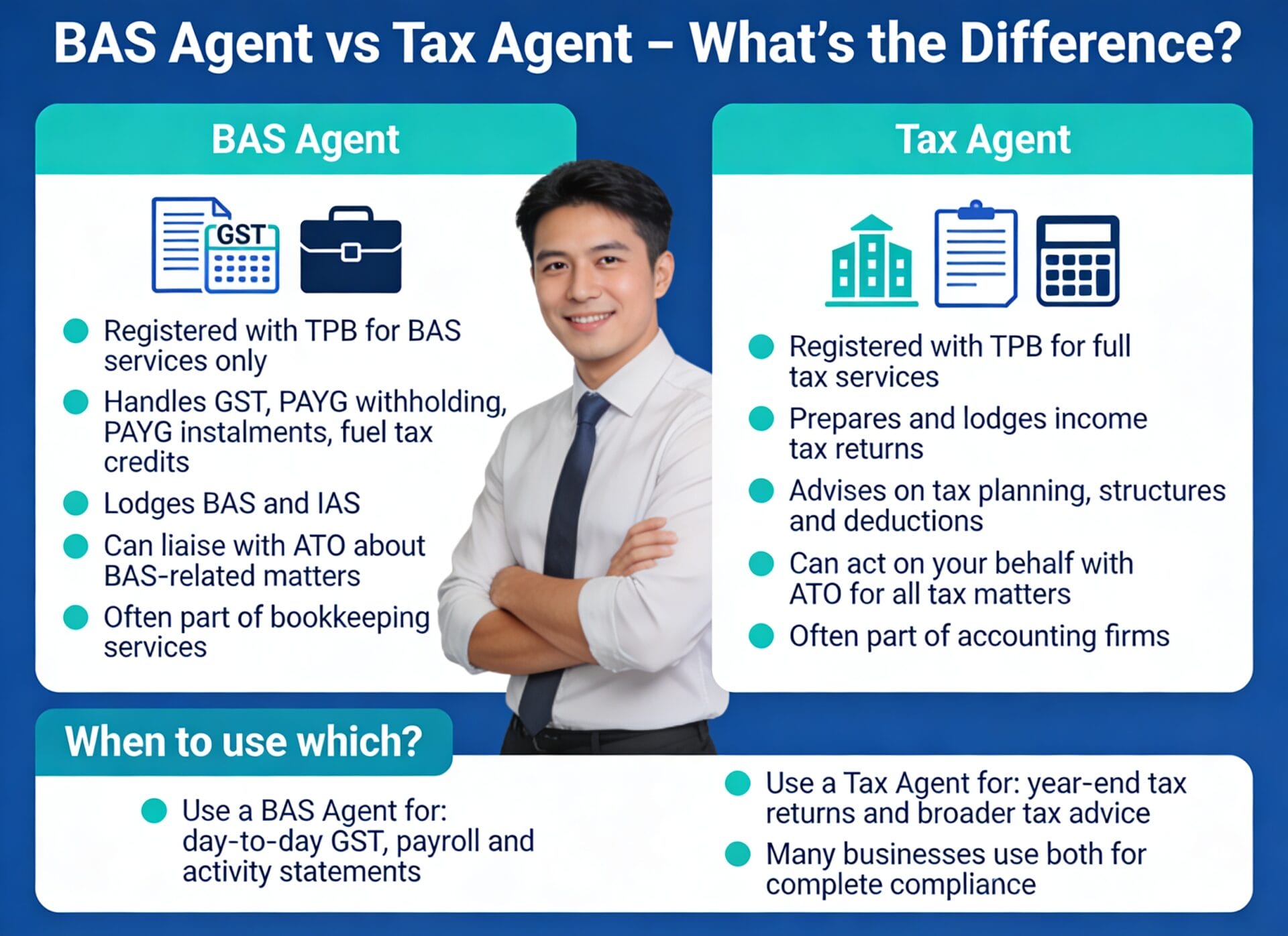
What is the difference between a BAS Agent and a Tax Agent?
The TPB defines the difference between BAS and Tax Agent as:
“A BAS agent’s scope is limited to BAS-related taxes and reporting (GST, PAYG, some FBT and super), while a tax agent can advise and act on the full range of taxation laws, including income tax and broader tax planning.”
In a practical sense, your BAS Agent is your specialist bookkeeper. They are in the driver’s seat of your daily operations managing receivables, payables, payroll, and GST. Your Tax Agent is typically your Accountant, focusing on high-level tax strategy, business structure, and your annual Tax Return.
While a Tax Agent is legally licensed to provide bookkeeping, they often operate at a “big picture” level. This is where core skills and attributes are important.
During my time at MYOB, a colleague once perfectly captured the difference: “Bookkeepers are all about details; Accountants are all about the big picture.”
While there are exceptions, most Accountants prefer the strategic view over transactional analysis. Proficient bookkeepers, however, thrive on the details, ensuring every cent matches perfectly, so your Accountant has a clean foundation to work from.
When accounting firms bundle bookkeeping into an “all-in-one” package, the service is often reduced to basic bank transaction coding. This high-level approach frequently neglects critical areas like Aged Receivables, Aged Payables, and meaningful management reporting. Furthermore, the burden of maintaining compliance paperwork is often shifted back onto the business owner.
In my experience, most business owners who choose these “all-in-one” packages often end up managing their daily operations in spreadsheets, essentially duplicating work with zero guarantee of accuracy. Whilst this could be a viable solution for micro businesses, when the business grows in both revenue and volume, this structure in simply unsustainable.
To achieve real growth, you need a strategic partnership forged by a proficient, registered BAS Agent who works alongside you and can present accurate and precise books to your Tax Agent (Accountant) who can focus on what they do best: tax planning and business strategy.
If I hire a Registered BAS Agent, am I automatically in safe hands?
Registration is the baseline, not a guarantee of quality. Just like any other profession, there are “bad apples” in the bookkeeping industry. While the Tax Practitioners Board (TPB) sets high standards, they are often stretched for resources when it comes to auditing the quality of work of their registered agents.
In numerous instances, registration is only suspended or cancelled after a grave error has already occurred. This means that “under-the-radar” agents can continue to operate and in the end, it’s the client who pays the ultimate price with fines or financial mess.
Being a BAS Agent is the essential first step, but it doesn’t replace the need for you to vet your bookkeeper’s knowledge, experience and work ethic.
What else should I look before engaging a good bookkeeper?
For many small business owners, it’s difficult to tell if a bookkeeper is doing quality work because this requires a financial level of expertise they typically lack, which is precisely the reason why they hire a professional.
Over the past few years, after witnessing some of my clients’ negative experiences, I have identified a number of red flags that small business owners should watch for when engaging a new BAS Agent.
🚩 The one size fits all approach 🚩
A professional bookkeeper should always kick off the engagement with a new client by scheduling a ‘discovery meeting’. This is a dedicated time a bookkeeper invest to learn about your business.
Topics of discussion should include:
- how you manage your sales;
- how you track your expenses;
- how you currently retain your source documents;
- how your Payroll is structured; and
- which Industry Award your employees are classified under.
During the meeting, the bookkeeper should also ask about your current pain points and discuss how your short and long-term financial goals are achievable and within certain timeframes.
This discussion gives the bookkeeper the opportunity to structure the accounts around compliance, industry standards and your individual business requirements.
In my opinion, any bookkeeper who takes on a client without any business meeting or review, represents a major red flag.
More than once I’ve taken over a client and, after reviewing their accounting setup, the overall structure was so bland and generic that the business could have equally operated in construction or hospitality. It gave no indication that the bookkeeper understood the client’s industry or that the client could run any meaningful financial reports.
Even if a bookkeeper is an industry veteran, don’t mistake their experience for a reason to stay silent. In fact, deep expertise usually triggers more questions, not fewer. When I onboard a client in a familiar sector like construction or childcare, I am prone to ask more granular questions from the start, than when I take a client in an industry I have not worked with previously.
🚩The software neutral attitude 🚩
Beware the bookkeeper who claims they can master any software on the fly. It is a major red flag when a bookkeeper suggests that your use or their lack of exposure and experience with your specific system won’t affect the quality of their work.
This attitude usually masks two underlying issues:
- A Lack of technical mastery: they likely possess only a high-level understanding of multiple platforms, rather than the deep, certified expertise required to optimise a tailored solution.
- A ‘Cookie-Cutter’ approach: it suggests they apply a generic workflow to every client, failing to leverage system-specific features that could streamline and customise your business operations.

A true expert will always advocate for the tools they’ve mastered because that is how they deliver their best work. When a bookkeeper has in-depth knowledge across a selected number of accounting platforms, they can proactively advise you on the one that offers the best strategic advantage for your specific industry or business requirements.
Although most accounting software share similar features, it’s the unique capabilities of each platform that allow a good bookkeeper to customise their workflows and add real value to your business operations.
For context, I’ve taught MYOB for five years and have used it since 2014, yet I’ve found that Xero is often the superior choice for the businesses I service. In my experience, using Xero increases my efficiency and accuracy by 25–30%. It allows for deeper customisation of management reports, and the report data easily flows to advanced worksheets I created that accurately calculate complex liabilities like Workers’ Compensation and Payroll Tax. These tasks are significantly more cumbersome in MYOB.
That said, I still maintain several clients on MYOB because Xero lacks certain niche features essential to their operations. Because I have extensive knowledge of both platforms, I can provide expert guidance on which system truly aligns with my clients’ industry and specific requirements.
My priority is delivering high-quality, tailored results. Therefore, when a new client is eager to engage my services, I ask them to either transition to one of the systems in our service portfolio, or, if they prefer to stay with a different software, I am happy to refer them to another professional who specialises in that package.
Finally, a word of caution: unless you are a micro-business not registered for GST, managing your books using Excel is simply too risky. If a prospective bookkeeper is willing to manage your accounts using manual spreadsheets rather than an accounting software, take it as a final red flag.
If they aren’t pushing for better solutions, you should be walking away.
🚩The high-volume bookkeeper 🚩
I generally view high-volume onboarding with a degree of healthy scepticism. Unless a firm is a very large-scale service provider, bringing on a new client every single week is often a sign that they won’t have the capacity to truly understand your business.
Rapid growth usually comes at the expense of discovery; without dedicated time to identify your specific requirements and current pain points, you risk becoming just another number. While this is difficult to spot from the outside, I would always encourage business owners to ask: ‘How many new clients do you commit to onboarding each month?’
🚩The Jack of all Trades 🚩
There is a worrying trend of businesses rebranding as a “one-stop shop” admin support for other businesses. They claim they can cover all business services including marketing, web design, bookkeeping. HR and recruitment services, all under a magical “admin services umbrella”.
In my experience, larger operations often rely on outsourced overseas teams with surface-level knowledge. Conversely, micro-businesses with only one or two people simply cannot maintain the deep expertise required to provide competent service across such diverse fields.
These “Jack of all Trades” businesses are often a calamity for the various professional industries. They can undercut professional rates for their services largely because they bypass essential accreditations and professional indemnity insurance, leaving their clients vulnerable to significant legal and financial risks.

Conclusions
Finding a proficient bookkeeper is about more than just outsourcing data entry, it’s about securing a foundational partner for your business. Your bookkeeper is your first line of defence against compliance issues and your best source of financial clarity.
When you are ready to engage a professional, don’t settle for anyone less than a Registered BAS Agent who can demonstrate these key traits:
- Prioritises Discovery: They are genuinely engaged in your business and invest the time to onboard you correctly.
- Understands your Industry: They either have extensive experience in your sector or the dedication to learn the multitude aspects of your industry.
- Values their Tech Stack: They offer a focused range of accounting solutions, rather than simply “making do” with whatever system their clients are using.
- Requires a full review of your Accounting file: They insist on looking “under the hood” to identify existing issues before quoting or starting work.
- Understands their niche: They specialise in high-quality bookkeeping services and perhaps branch out to no more than one or two adjacent areas (like advisory, administration or HR), rather than over-promising on everything.
More importantly, look for a professional whose values and work ethic mirror your own. When your bookkeeper cares as much about your business finances as you care about your vision, you have the perfect recipe for growth.
References
https://www.tpb.gov.au/Registered-tax-practitioner-symbol
Disclaimer
This blog and attached resources are of general nature designed for informational and educational purposes only. They should not be construed as professional financial advice for your individual business. Should you need such advice, consult a licensed financial or tax advisor.


