
Is Your Business Ready for the October 2026 Surcharge Ban?
By Paolo, 27.09.2026

From 1 October 2026, Australian businesses can no longer add a surcharge to card payments collected from customers.
This upcoming regulation spans across credit, debit and prepaid card transactions nationwide paid by EFTPOS, Visa, Mastercard, American Express and other card types.
What’s changing from 1 October 2026?
Effective 1 October 2026, the ban on merchant surcharging means businesses must absorb their card processing costs. While banks will still charge merchants to accept these payments, these overheads can no longer be passed on to consumers.
This change applies to all card payments made on or after 1 October 2026, irrespective of the original sale date.
The credit surcharge ban directly affects the EFTPOS, Mastercard, and Visa networks, as these fall under Australian law, and directly under RBA regulations.
In a coordinated move, non-designated networks including American Express, JCB, and UnionPay have also banned surcharging from the same date.
Other payment platforms, which do not fall under the direct RBA regulatory scope, are exempt from this ban, including:
- Buy Now, Pay Later (BNPL);
- Digital Wallets (Apple Pay, Google Pay);
- Payment Gateways and Facilitators;
- Electronic Funds Transfers (EFT);
- Emerging Payment Modules and platforms.
The RBA has also introduced a second (and widely underreported) change to credit card fees by imposing a cap to the ‘interchange fees’ payable by the businesses to the card providers.
These caps are being reduced for both debit and credit card payments with the explicit goal of reducing the cost of card acceptance, particularly for small merchants, who have historically paid rates at or near the regulatory cap.
The interchange fees caps from 1 October 2026 are:
- Domestic Debit/prepaid cards: capped at 8 cents, or 0.16% (whichever is lower);
- Domestic Credit cards: capped at 0.3%;
- Commercial cards: cap stays at 0.8%;
- Foreign-issued cards: capped at 1.0% (from 1 April 2027).
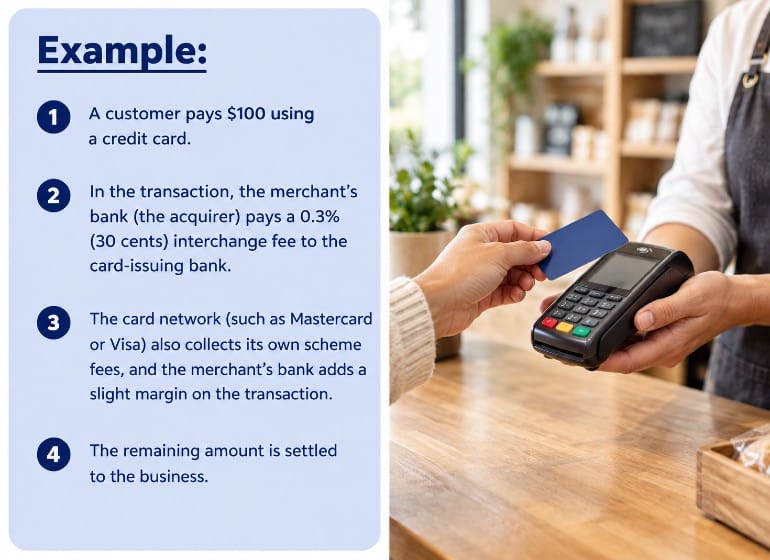
 What is a card surcharge fee? What is an interchange fee? |
Why the Change?
Credit Card surcharge fees were originally introduced to help businesses pass on card costs and encourage lower‑cost payment methods.
Following a consumer review, the Reserve Bank of Australia found that the existing surcharge framework was complex, inconsistent, and lacked transparency for consumers purchasing goods and services. With 76% of Australian consumers wanting surcharging to end, the RBA determined it was in the public interest to ban added fees on card payments. The change is designed to make payments simpler and help clients understand the full cost of a service upfront.
To implement the ban, the RBA has officially lifted its restrictions on “no-surcharge” rules originally implemented on 1 January 2003, allowing these card networks to legally prevent merchants from charging card fees at point of sale.
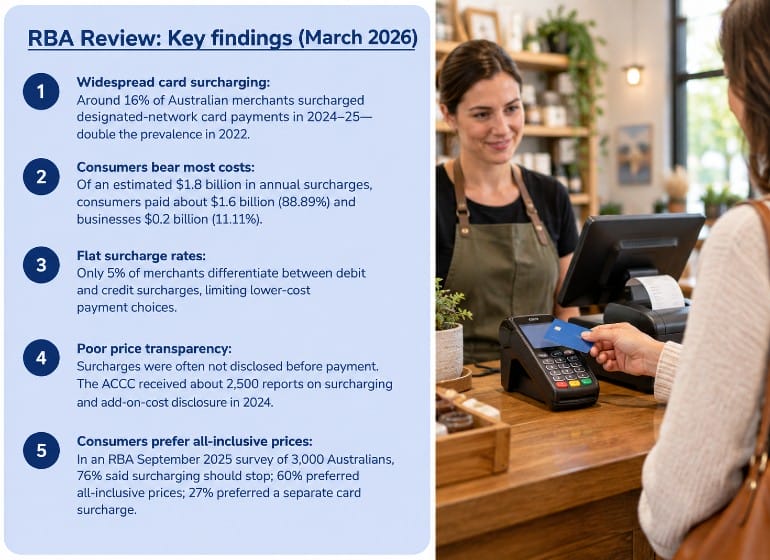
Who is impacted by this change?
The impacts of this reform diverge significantly depending on whether a consumer is paying with a credit card or a business processing the transaction.
1. Individual and Business Consumers
Individual and business consumers using credit cards for their purchases are the “obvious” direct beneficiaries of this change. This regulatory shift introduces complete price transparency; by eliminating hidden checkout fees, the RBA predicts consumers will see immediate, direct savings on everyday card transactions.
However, these savings come with a potential hidden catch. Because businesses must still pay bank fees to accept card payments and can no longer pass these costs on as a separate line item, the retail prices of goods and services may surge to absorb these overheads.
This shift ultimately risks impacting those consumers who normally pay by cash or alternative methods, who will now cross-subsidise the cost of the surcharge fees, even if this is not their preferred method of payment.
Additionally, business consumers who rely on credit cards may lose that option entirely if smaller service providers drop card payments to avoid unrecoverable merchant costs.
2. Businesses who traditionally absorbed card fees
Businesses that have historically absorbed payment processing fees stand to gain the most from this reform. Unlike competitors who must now restructure their pricing, these merchants are set to increase their profit margins due to the lowering cap of interchange fees, all while keeping their existing prices.
3. Businesses who traditionally passed the card fees as a surcharge
Businesses that have traditionally passed card fees onto their customers now face the critical decision of how to manage these newly unrecoverable costs.
The most suitable approach varies significantly depending on industry type, business size, and the overall reliance on card payments for daily operations and cash flow.
As the option to pass the fee as an “add-on cost” is now precluded, these merchants must first correctly categorise the financial impact of these fees as one of the following types:
- as a direct cost – and choose to recover the lost revenue by increasing their prices.
(common option for retail or hospitality businesses whose majority of transactions are paid at point of sale by card); - as an operating cost – and decide to absorb the processing fees entirely.
(typical for businesses that rely primarily on other payment methods, such as direct bank transfers, and rarely process card transactions); - as an unrecoverable cost – and ultimately decide to stop offering card payment options altogether, or only accept them as a last resort to prevent bad debts write-offs.
(common for service providers or B2B businesses where online or card-not-present processing fees are significantly higher than standard point-of-sale terminal rates)
A great video summary of the Credit Card Ban produced by Aussie Money Explained
What can businesses do to cover the loss of the surcharge fees?
For many businesses, surcharging has historically served as a straightforward mechanism to offset the direct overheads of electronic payment acceptance. However, the ability to pass on these transaction fees extends far beyond simple cost recovery; it plays a critical role in a business’s broader operational strategy.
Merchants must carefully balance customer expectations and competitive pricing against cash flow demands. Because these choices have both direct and indirect consequences for a company’s operational workflows and cash flow, they should be evaluated as part of a holistic pricing and cost-management strategy.
The optimal solution depends on a combination of transaction volumes, profit margins, customer payment behaviour, and working capital needs. Consequently, the right approach will vary significantly based on business size, current gross profit (GP) margins, and industry type.
For businesses where card payments help secure faster invoice settlements, absorbing the transaction fees may prove commercially advantageous. Faster payments typically improve cash flow, lower average debtor turnaround times, and significantly reduce backend administrative tasks.

When evaluating a cost-recovery strategy, merchants should consider the following key aspects:
- Identify where the cost sits: Determine which payment channels carry the highest card processing expenses, and factor these merchant fees directly into the cost of sales.
- Evaluate pricing models: Build card-processing costs into overall retail pricing, or absorb them entirely if the cash flow and administrative benefits justify the expense.
- Promote lower-cost alternatives: Introduce or emphasise lower-cost payment methods, such as direct debit, within the suite of options offered to clients.
- Benchmark digital solutions: Review current online payment gateways and compare them against competing providers to ensure the setup remains the most commercially viable option for operational needs.
What should business do to ensure they stop charging card fees?
To seamlessly transition into compliance ahead of the 1 October 2026 deadline, businesses must first prioritise their regulatory compliance and ensure that any device or application used to collect card payments is configured to no longer pass surcharge fees onto their customers.
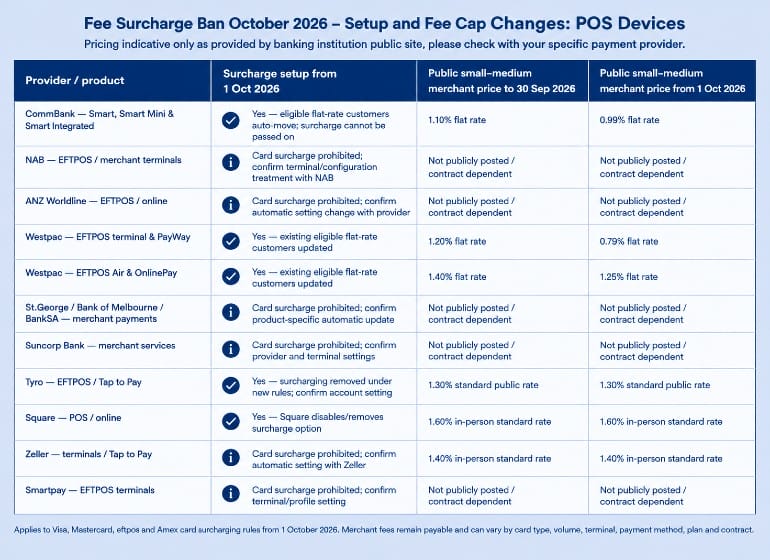
While major banks and online merchant gateways (such as Square, MYOB or CBA and NAB) have informed merchants that these surcharge settings will be automatically disabled in the backend, businesses cannot rely blindly on automated fixes.
It is critical to proactively review all recent communications and software updates from payment providers to confirm that the transition will execute correctly, with or without direct merchant intervention.
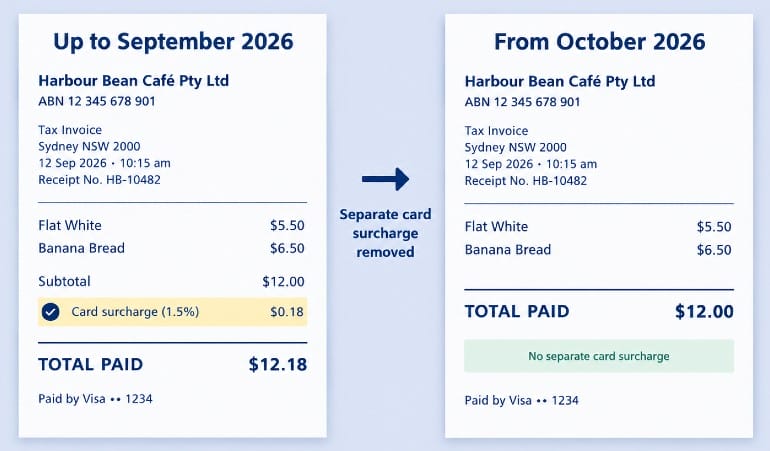
It is also advisable for all merchants to conduct a test transaction to verify the formatting of receipts generated by their POS terminals and invoicing systems and ensure that printed or digital receipt no longer feature an itemised line item for surcharge fees.
Summary of POS Devices Automatic Setup Configuration and fee comparison before and after 1 October 2026.
Summary of Online Payment Providers Automatic Setup Configuration and fee comparison before and after 1 October 2026.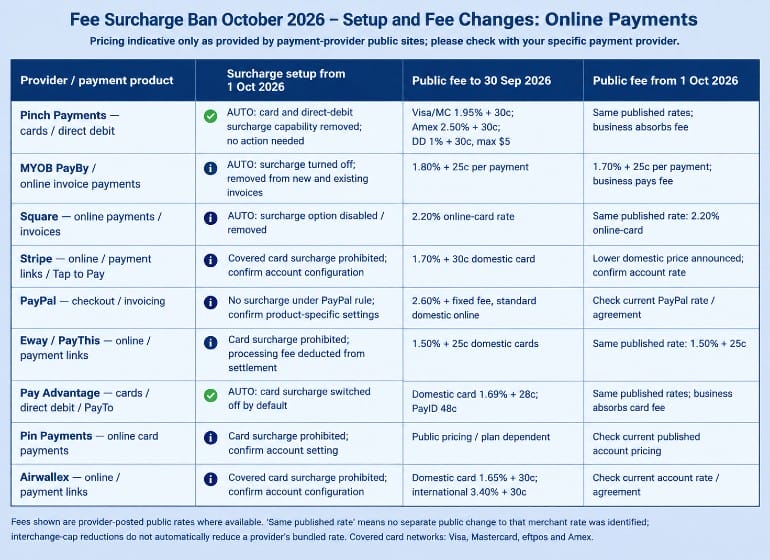
What should businesses do to prepare for this change?
Beyond the required hardware and software updates, preparation extends across the entire digital ecosystem, including online checkouts, invoicing platforms, and other systems.
Operationally, businesses must audit and update all customer-facing materials and formal documentation, including terms & conditions of payments outlined in client agreements or at the bottom of invoices that stipulate how card fees are managed. This documentation must be formally amended to reflect the zero-surcharge environment starting from 1 October 2026.
Physical counter signage, digital checkout notifications, menu footnotes, and any other marketing material referencing card-handling fees must also be reviewed, updated, or removed.
What are the consequences for businesses who continue to on-charge fees after 1 October 2026?
Business accepting card payments
For businesses accepting card payments, non-compliance with the 1 October 2026 ban carries swift contractual and regulatory enforcement.
If an isolated surcharge occurs accidentally, the merchant can manually reverse the transaction and refund the fee. However, continued or deliberate breaches of the surcharging ban will result in severe penalties. Furthermore, as the ban is enforced directly through merchant service agreements, card networks and banks hold the authority to suspend or terminate a business’s card-processing facilities entirely, while the Australian Competition and Consumer Commission (ACCC) retains the oversight to prosecute misleading pricing or illegal fee structures under Australian Consumer Law.
Crucially, this prohibition is not limited to automated surcharges configured via point-of-sale terminal software. Merchants are strictly prohibited from implementing workaround strategies, such as adding manual contract clauses or verbally stating that an extra fee will be manually applied if a client decides to pay by card.
Individual Consumers
Consumers who encounter a business that continues to apply a card surcharge, whether automated at the terminal, itemised on a receipt, or manually calculated at the counter, can report this non-compliant business to either the ACCC or their card-issuing bank.
These reports prompt formal regulatory investigations, which can result in the ACCC issuing infringement notices and substantial financial penalties, or the relevant card network auditing the merchant for breaching their card-acceptance agreement.
Conclusion
Consumers and small businesses are bracing for one of the largest changes in payment processing in Australian history.
By eliminating point-of-sale checkout fees across major networks, the reform effectively replaces surprise terminal fees with absolute price transparency for the everyday consumer.
However, this change will result in a simplification of purchase pricing rather than true savings. Because merchants will continue to incur processing fees, albeit reduced, most businesses will find a way to on-charge these costs by increasing the base price of their services.
For merchants moving forward, compliance must remain the immediate priority. To avoid severe contractual and regulatory enforcement from banks and the ACCC, businesses must meticulously audit their point-of-sale systems, billing platforms, contract clauses, and marketing signage before the deadline.
While the ban shifts the operational landscape, it also encourages businesses to streamline their digital ecosystems, look out for wholesale savings stemming from the RBA’s reduced interchange fee caps, and establish transparent customer pricing models optimised for long-term growth.
References
https://www.commbank.com.au/articles/newsroom/2026/08/commbank-reduces-fee-card-surcharging.html
Disclaimer
This blog and attached resources are of general nature, designed for informational and educational purposes only. They should not be construed as professional financial advice for your individual business. Should you need such advice, consult a licensed financial or tax advisor.


