
Payday Super July 2026: Impact on Employers & Employees
By Paolo, 11.06.2026

Payday Super represents the most significant update to the Australian Superannuation System since the introduction of SuperStream in July 2014.
From 1 July 2026, Payday Super officially replaces quarterly deadlines, mandating that businesses pay Superannuation on the same day they pay salary and wages.
Despite the scale of this change, it is important to understand that the core concepts of Superannuation, including worker eligibility rules, legislated rate, and earnings used to calculate the statutory contribution, remain essentially the same.
The core goals of this reform focus on the increased payment frequency and the enhanced reporting transparency, allowing the ATO to capture those employers who purposely fail to comply.
Workers stand to benefit the most from this change, as the reform is designed to improve retirement outcomes by ensuring more frequent deposits into individual funds.
For employers, the impact of Payday Super may vary significantly depending on their business model and industry sector.
Businesses that rely on daily cash flow intake will likely see more predictable cash flow management, as they will no longer have to deal with large quarterly liabilities.
However, for businesses whose models rely on monthly billing cycles, an additional 12% weekly cash outflow will definitely put a strain on their financial resources, especially at the start of this process.
For the Australian Taxation Office (ATO), this shift represents a move toward near real-time visibility. With new reporting requirements imposed on payroll software, the ATO can instantly data-match payroll records with super fund receipts to flag discrepancies.
While the legislation may be perceived as “unfair” by some employers, it provides the ATO with the discretion to review an employer’s compliance history and voluntary disclosures before deciding whether to apply penalties or leniency, as opposed to the rigid penalty structure of the previous regulations.
For payroll consultants, the transition to Payday Super demands a complete operational restructure to align superannuation processing, reporting, and cash flow management with each pay cycle. As a result, maintaining a strong, proactive partnership with clients is more critical ensure long-term financial survival.
The reform was announced in the 2023–24 Federal Budget on 2 May 2023. Following a period of extensive consultation with industry stakeholders, the legislation officially received royal assent in November 2025.
Payday Super officially starts on 1 July 2026. However, employers can start paying super on pay day any time before the official date.
The Shift from Ordinary Time Earnings to Qualifying Earnings
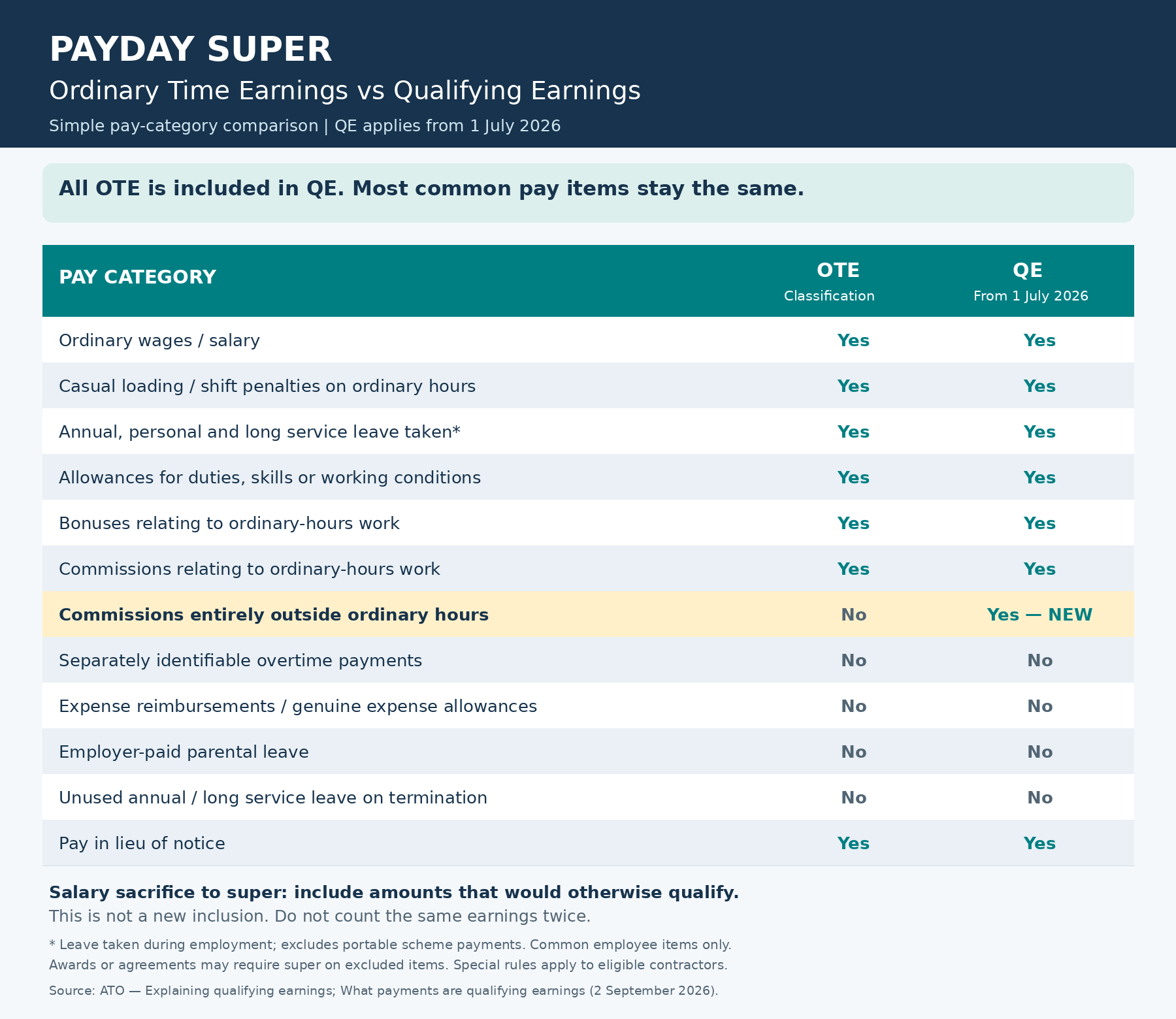
Starting from 1 July 2026, Superannuation is no longer calculated on Ordinary Time Earnings (OTE), but on Qualifying Earnings (QE).
This is more a new “label” than an entirely new classification of earnings. Despite the change in terminology, the calculation method itself remains virtually unchanged, with only one significant difference: Qualifying Earnings now includes all commission payments, whereas previously, some commissions were not deemed OTE.
Employers and payroll professionals can rest assured that this is not a legislative change to what constitutes superable wages, requiring them to learn a new set of rules. With the exception of reconfiguring specific commission pay items in their payroll system, they simply need to adopt the updated terminology ahead of the July 2026 deadline.
Compliance Requirements: Beyond the “Payday” Tagline
Media coverage consistently promotes the Payday Super reform by using the following tagline: From 1 July 2026, employers must pay their employees’ super contributions the same day they process their wages.
However, this is an oversimplification of the actual ruling. The legal text focuses on the processing window rather than the payday itself.
In short, the rule states: Superannuation contributions must be successfully received by the employee’s super fund within 7 business days of the “Qualifying Earnings day” (which is the actual payday).
The critical term in the legislation is received. The law does not acknowledge when an employer initiates the transfer; it focuses specifically on the day the payment is received and allocated by the employee’s super fund.
According to the ATO ruling, an eligible contribution is considered to be made only once it is received by the relevant Superannuation fund and allocated to the employee’s account.
This requirement is no different from the previous legislation, which stipulated funds had to be received by the Superfund by the 28th day of the month following the end of a quarter.
As under the previous ruling, employers still have to account for processing times to ensure payments arrived on time. The fundamental difference now is that employers have a very limited number of days to comply, meaning the only reliable way to guarantee compliance is to initiate the super payment directly on payday.
The Superannuation Payment Process
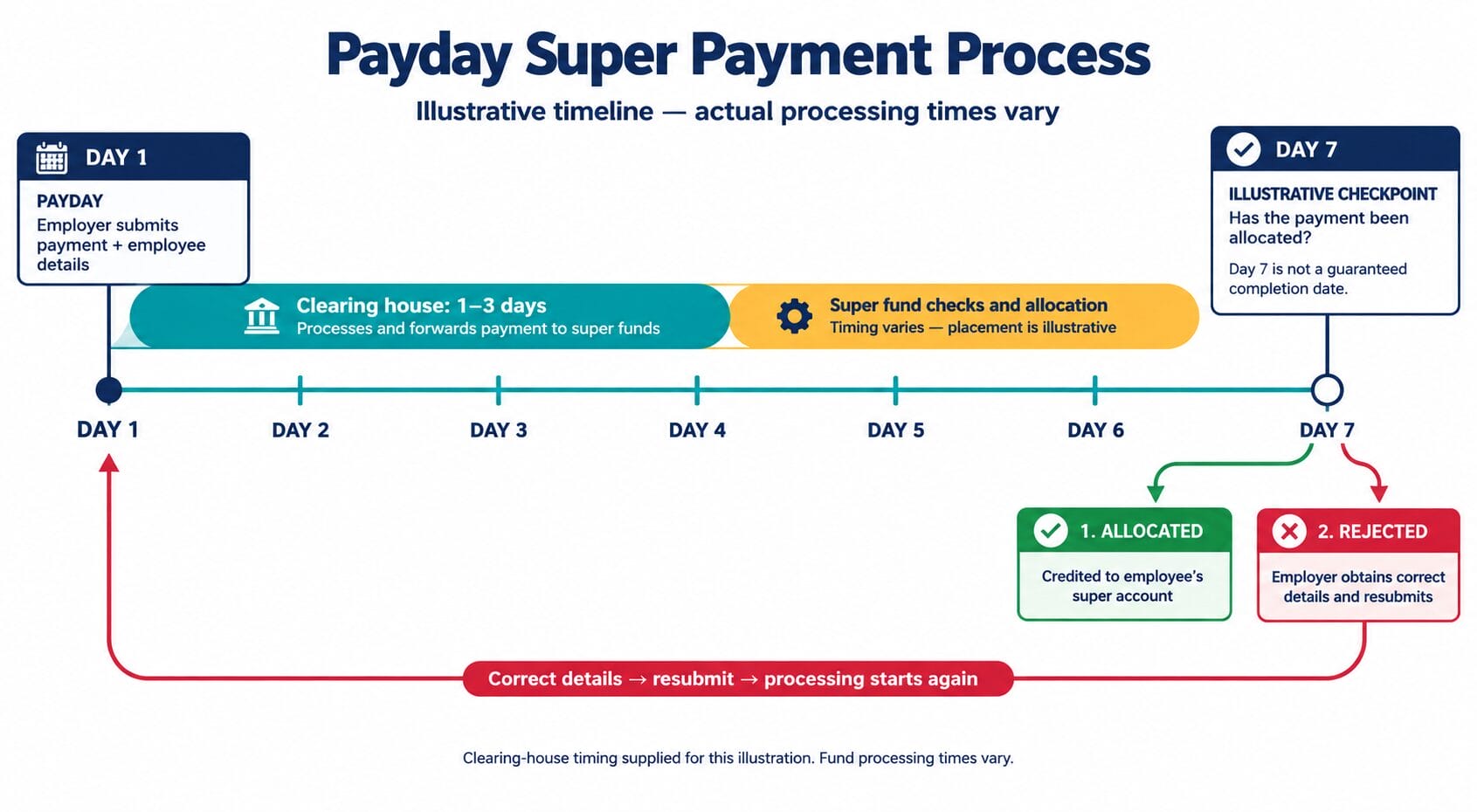
For employers, the process of paying Superannuation to their employees is not a direct line. As stipulated by SuperStream rules introduced in 2014, Superannuation contributions must be sent in a compliant electronic format through a Clearing House.
This means a number of intermediaries come into play, directly impacting the gap of time between the day the employer initiates a transfer and the day the funds are formally received by the employee’s fund.
Employers have little to no control over influencing the processing time taken by these intermediaries. Yet, they are fully liable for payments not reaching the employees’ funds on time, even when the original payment was made on payday and clearly could not have been made sooner.
It is also important to understand that the 7-business-day deadline, covers all super payments related to the specific QE Day (or Payday) including any rejected payments sent back to the employer by the Super funds or the clearing houses.
Furthermore, employers have very limited visibility to the actual date the funds are credited into the employees’ Superfund, making it almost impossible for them to determine whether they are complying with the ruling or not.
The 7 Business Day Ruling and its Exceptions
For the purposes of this 7-day timeline, a “Business Day” is defined as any day that is not a Saturday, Sunday, or a public holiday. The countdown pauses on weekends and national or statewide public holidays. If a public holiday applies to an entire state or territory, that day is excluded from the business day calculation nationwide. However, regional, local, or part-day public holidays (such as a local show day or a municipal holiday) are still treated as regular business days.
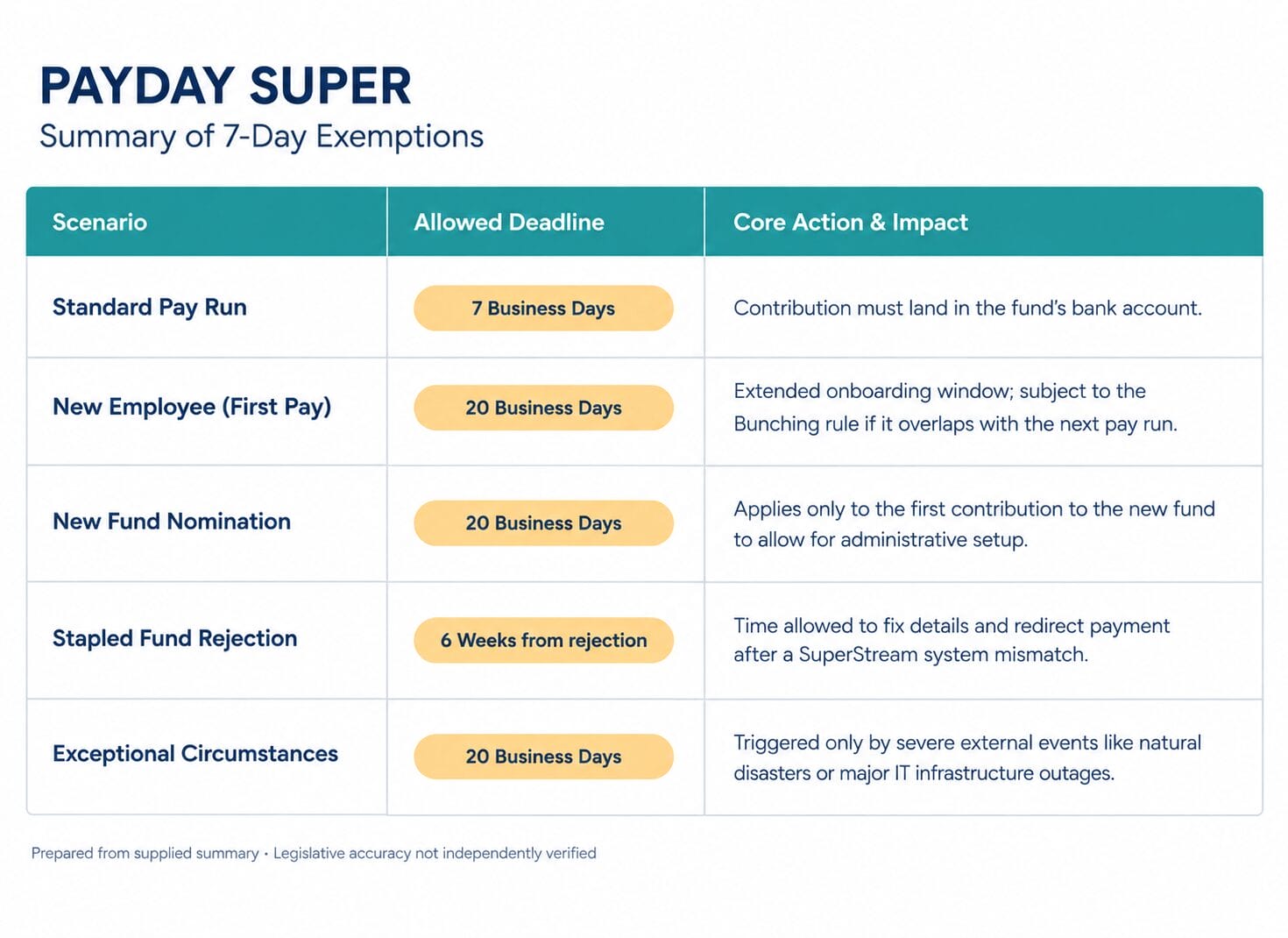
While the 7 business day rule is strict, Payday Super includes extensions and exemptions under the following scenarios:
New Employees
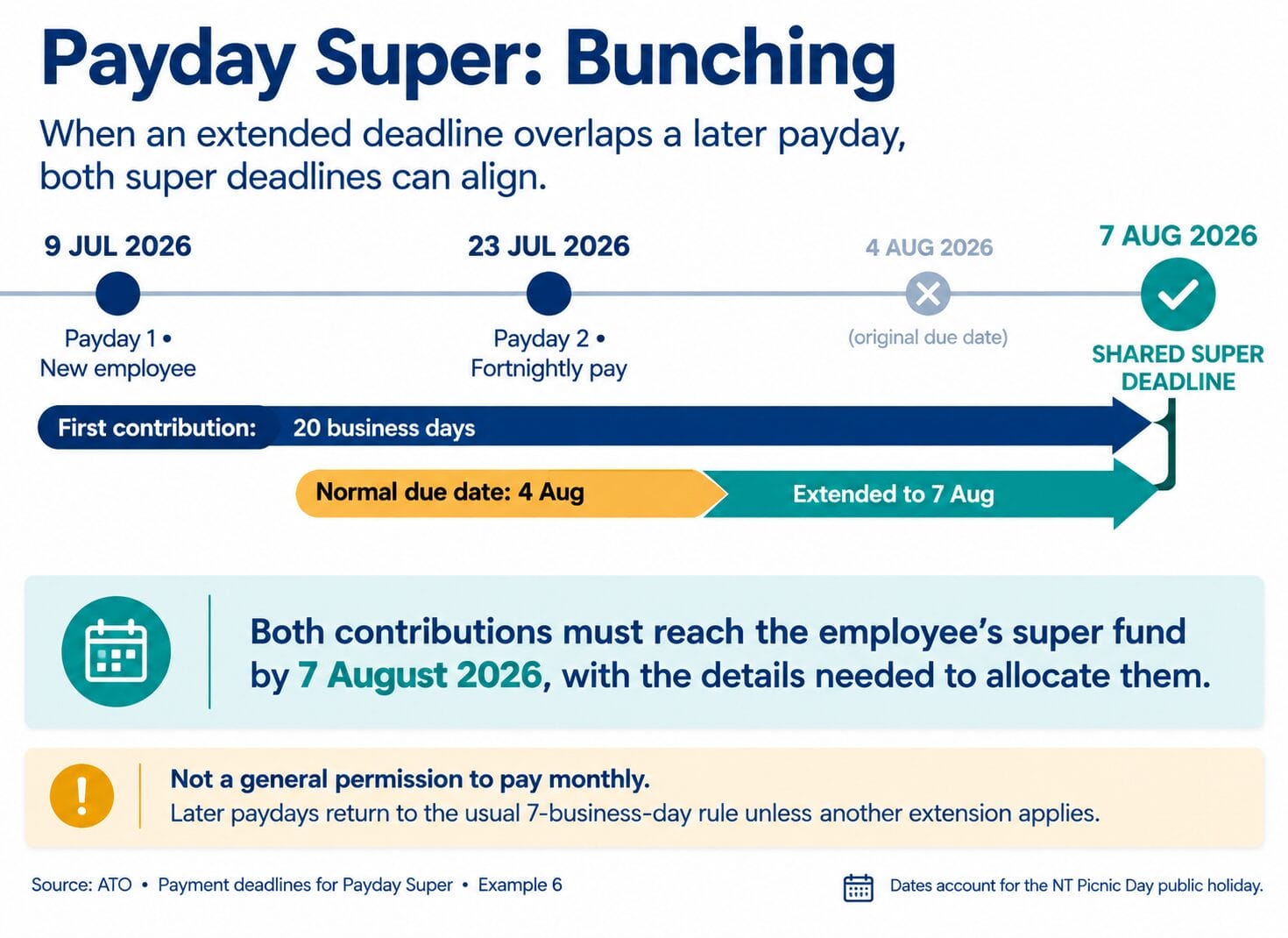
For a newly hired employee’s very first pay cycle, employers are granted an extended 20 business day deadline to allow time for onboarding and setting up fund details.
This triggers the concept of “Bunching.” If the extended 20-day window for the new hire’s first pay run overlaps with the standard 7-day deadline of the following pay runs, the due dates are grouped together. To simplify compliance, when a subsequent regular deadline precedes the extended first deadline, both contributions share the extended due date.
Changes to an Employee’s Super Fund
When an existing employee opts to change Superfund, the deadline for the first payment to that newly nominated fund is extended to 20 business days from payday, allowing the business the necessary time to complete the additional admin tasks. Subsequent payments to the new fund revert to the standard 7 business day limit.
Incorrect Super Details from Stapled Request
If an employer attempts to pay contributions into an employee’s fund as a result of a stapling fund request and the transaction is rejected due to mismatched or incorrect system data, a 6-week grace period automatically applies.
Super funds are legally required to bounce unverifiable funds within 3 business days. In these scenarios, the employer has 6 weeks from the date of the rejection to rectify the information and successfully redirect the payment without triggering a Super Guarantee Charge (SGC).
Exceptional Circumstances
The ATO also has the power to grant a class-wide extension when an employer is disrupted by events entirely beyond their control. Exceptional circumstances strictly refer to severe external disruptions, including widespread natural disasters (like floods or bushfires) that physically halt business operations, or major, systemic information technology and telecommunication outages that completely freeze banking systems or payroll infrastructure.
Initiatives Taken by ATO to Improve the Super Payment Process
While the new legislation places clear legal liability on the employer for failing to make timely payments, the ATO has introduced a suite of measures to improve the super payment system and support businesses making every effort to comply.
These initiatives include:
Accelerating processing times
The ATO is collaborating with digital service providers, super funds and clearing houses encouraging them to adopt a new payment technology: NPP (New Payments Platform) which allows funds processing in less than 48 hours. The goal of this strategy is to limit the “gap of time” between payday and the time the funds are credited to the employee’s Superfund.
Improved error transparency
The ATO has also requested an upgrade to SuperStream data requesting detailed reason codes to give employers clearer information when a payment is rejected, making it easier to quickly rectify mistakes and promptly resubmit payments.
Member Verification Requests (MVR)
To prevent transaction failures, the ATO is introducing the Member Verification Request (MVR) process within updated payroll and employee onboarding software applications. This digital tool allows employers to verify an employee’s member number before making the first contribution.
Direct Access to the Super Fund Lookup (SFLU) Registry
Furthermore, the ATO is integrating payroll platforms directly with the official Super Fund Lookup (SFLU) register. This allows systems to automatically check whether an employee’s nominated fund is still active (Self-regulated funds) or legally compliant (SMSF) before transferring funds. By instantly flagging inactive or deregistered funds, this upgrade prevents employers from mistakenly sending payments to closed funds.
A risk-based compliance transition period
Finally, the ATO has introduced a transitional risk-based compliance period, by adopting an educational, supportive approach during the first 12 months of the implementation of the new ruling.
During this period, the ATO will use administrative discretion to avoid penalising those employers who make every effort to comply with the new deadlines and try to promptly address processing errors and rejected payments.
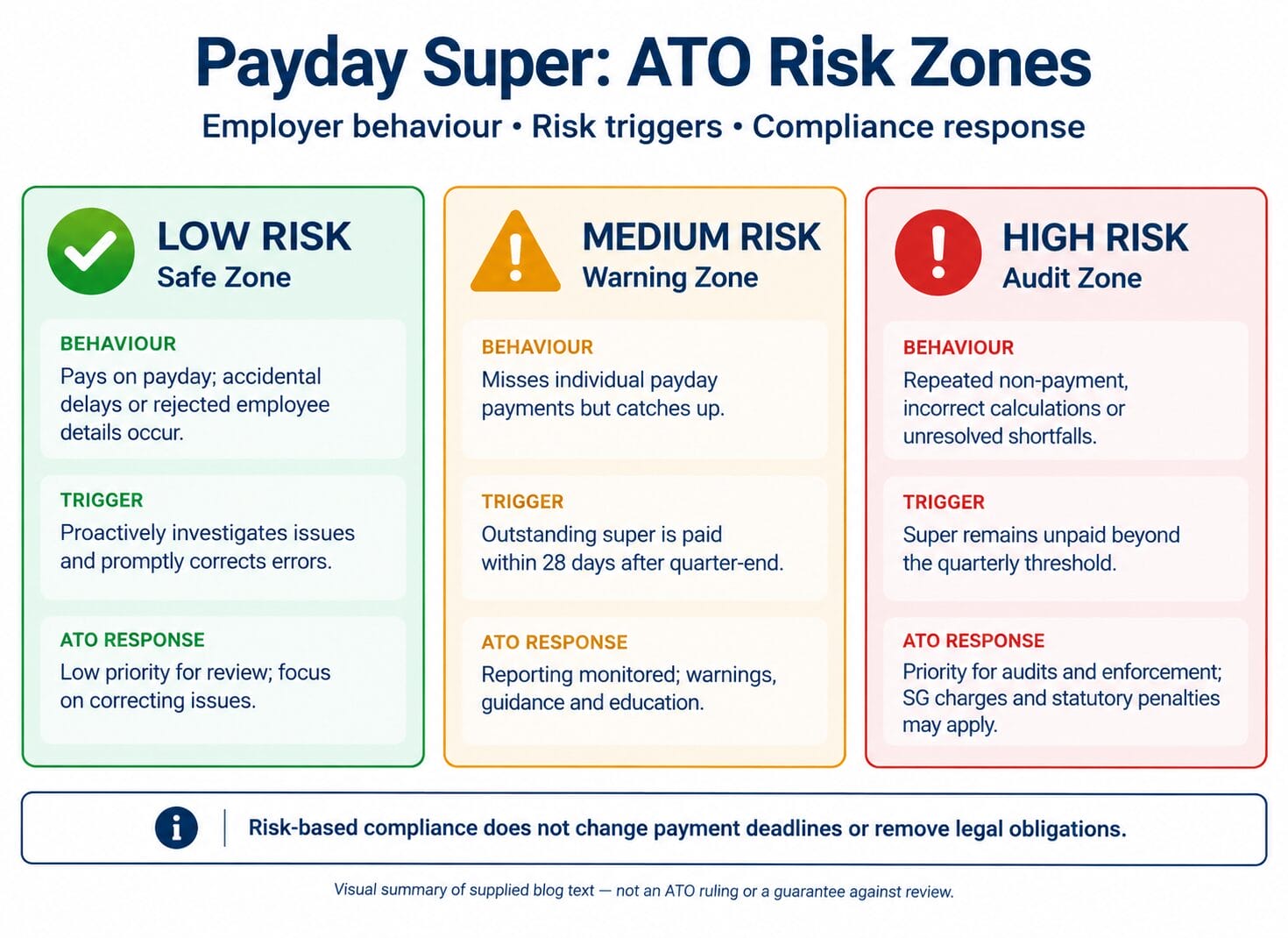
In details the ATO will classify business behaviour across three tier risk level “zones”.
🟢 Low Risk (Safe Zone)
This zone applies to those employers who are actively trying to pay on payday but experience accidental processing delays or errors (such as a fund rejecting data due to incorrect employee details).
- The trigger: Businesses pay super on pay day, delays and rejections occur, they proactively attend to any issue and promptly rectify any errors.
- ATO action: the ATO will not review these operations, giving companies the operational peace of mind needed to focus on managing their day-to-day operations.
🟡 Medium Risk (Warning Zone)
This zone applies to those employers who fail to process Superannuation contributions concurrently on payday but ensure the late payments are settled before the quarterly deadline.
- The trigger: Businesses may miss individual payday deadlines, but successfully catch up on all outstanding liabilities within 28 days after the end of that specific financial quarter.
- ATO action: While the ATO will monitor reporting data from these employers, it will focus on sending notifications, providing guidance and education, rather than applying penalties, allowing organisations time to adjust to the new payday deadlines.
🔴 High Risk (Audit Zone)
This zone applies to employers who intentionally bypass the payday frequency, incorrectly calculate Superannuation, or allow individual SG shortfalls to remain unrectified past the quarterly threshold.
- The trigger: Businesses persist in missing Superannuation payments or making late Superannuation payments past the quarterly threshold.
- ATO action: High-risk classified companies will become a priority target for formal ATO audits and compliance enforcement. The ATO will focus its compliance resources on these organisations, issuing Super Guarantee Charges and apply statutory penalties.
The ATO will continue to monitor Australian businesses throughout the first financial year and may shift an employer from one zone to another based on changes with their ongoing payment patterns.
Additional Legislative Changes
Key structural changes under Payday Super go beyond the payment frequency deadlines. The ATO has also made the following changes to the previous Super Ruling:
Maximum Super Contribution Base Shifts to An Annual Calculation
The maximum contribution base formally shifts from a quarterly to an annual threshold. This adjustment streamlines the payroll calculation process allowing employers to assess super limits smoothly across the entire Financial Year rather than checking individual quarterly periods.
Removal of the Late Payment Offset (LPO)
Under previous regulations, employers could reduce their penalty debts by offsetting late payments made directly to an employee’s super fund against their outstanding Superannuation Guarantee Charge (SGC). Under the new Payday Super ruling the Late Payment Offset has been abolished, and late remittances can no longer be offset against an outstanding debt.
ATO-Issued Superannuation Guarantee Charges
The ATO has also taken the responsibility for calculating and issuing the Superannuation Guarantee Charge (SGC) using data-matching retrieved from Single Touch Payroll, removing the previous requirement for employers to manually self-calculate and lodge their own shortfall statements.
While the ATO will take over the initiation of these penalty notices, businesses still retain the right to submit a voluntary disclosure statement to proactively report errors and request penalty reductions based on their compliance history.
Discretionary Penalty Application
Another fundamental compliance shift involves how penalties are enforced against late payments. Under the previous ruling, the ATO had no choice but to apply blanket penalties to any business that missed a super payment deadline, even by a single day. The legislation did not include a statutory course for remission, regardless of the employer’s payment history.
Conversely, Payday Super allows the ATO to apply administrative discretion when assessing penalties. The penalty application process will be based on an employer’s overall behavioural patterns and compliance track record, rather than triggering automatic fines for small or accidental breaches.
Detailed information regarding these new penalties and how they are structurally applied will be covered in an upcoming, separate article.
Conclusions: Preparing for the New Payment Timeline
The transition to Payday Super marks a permanent departure from the quarterly payment cycles, transitioning Superannuation from a seasonal liability into a payday obligation.
Ultimately, the successful implementation of Payday Super depends on how effectively an organisation can synchronise its working capital with its payroll calendar.
Small businesses can protect their operations by preparing for this new transition and focusing on the following areas:
- Realign cash flow planning:
conduct a comprehensive review of their cashflow and make adjustments to accommodate for an extra 12% outflow for every pay period. - Improve employee onboarding processes:
transition away from paper-based onboarding processes toward digital onboarding workflows. Utilising digital platforms that offer automated Member Validation Requests (MVR) and integrated electronic data-gathering tools eliminates manual transcription and clerical mistakes, ensuring that incorrect fund details or mismatched Single Touch Payroll (STP) files do not trigger payment rejections. - Verify commission and other pay item configuration
reconfigure internal pay categories, ensuring their payroll set up is Payday Super ready. - Establish a backup system of super approvers:
nominate additional superannuation authorisers to avoid payment delays in the case of unexpected absence by the primary responsible party. - Nominate a fully funded bank account:
select a bank account that consistently holds sufficient funds to cover the recurring payment demands, preventing rejections due to insufficient funds. - Develop a rapid error-rectification strategy:
implement an internal monitoring process to actively audit payment rejections to promptly troubleshoot and re-submit failed transactions, ensuring corrections are finalised within the 7-business-day deadline.
To assist employers with this major transition, the ATO has developed a comprehensive suite of information, interactive guides, and checklists.
However, Payday Super is simply the latest in a continuous cycle of complex legislative reforms that challenge business owners to maintain payroll compliance. Outsourcing these liabilities to an external payroll expert is the most effective way for organisations to protect their working capital and guarantee compliance.
At Evolution Cloud Accounting, we handle the technical complexities of your payroll ecosystem so you can focus entirely on scaling your operations. Don’t leave your compliance to chance, Contact Us and discover how we can streamline your transition ahead of any legislative deadline.
References
https://www.ato.gov.au/law/view/view.htm?docid=%22COG%2FLCR20263%2FNAT%2FATO%2F00001%22
Disclaimer
This blog and attached resources are of general nature, designed for informational and educational purposes only. They should not be construed as professional financial advice for your individual business. Should you need such advice, consult a licensed financial or tax advisor.


