
Differences between Juniors, Apprentices and Trainees
By Paolo, 31.01.2026

It is an indisputable fact that personnel is the highest cost for all businesses, regardless of their size.
With the ongoing increase in minimum wages, superannuation and workers’ compensation, Australian businesses are constantly seeking effective ways to decrease employment costs.
The most common strategies to reduce employment expenses are: implementing new technologies, outsourcing work to countries with cheaper labour and hiring new entrants to the workforce or the industry sector.
While a selected number of employers may be able to adopt all three strategies, generally speaking, each option is more appropriate to certain industries than others.
The implementation of new technologies is often an option adopted by the Manufacturing Industry and by Fast-Moving Consumer Goods (FMGC) in an attempt to automate repetitive working tasks previously managed by workers.
Outsourcing is an investment generally appropriate for service-based industries, including call centres, accounting, administration and marketing.
Other industries, including Building and Construction and Child Minding, tend to look at hiring new entrants to the workforce or their sector to cut down employment costs. These types of employees include: Junior employees, Apprentices and Trainees.
This blog reviews the differences between Junior employees, Apprentices and Trainees, by providing an overview of the financial benefits and hidden costs and summarising the compliance and record-keeping requirements that apply when hiring these employees.
This article does not apply to labour-hire companies, as these businesses are subject to different rules and regulations.
Differences Between Junior, Apprentices and Trainees
Definition of Junior Employees, Apprentices and Trainees
Junior Employees
A junior employee is an employee who is under a certain age (generally 21 yo) as determined by the relevant Industrial Instrument.
Whilst some employees may be considered “juniors” due to their skill levels and experience, they can only be classified and paid as Junior Employees on two conditions: the classified Industrial Instrument includes junior rates and the employee’s age reflects the age brackets stipulated by such Industrial Instrument.
Junior employees are entitled to two pay increases per Financial Year: on their birthday, as they move to the next age bracket, and on the first week of July, as part of the Fair Work minimum wage annual review. Employers should consistently monitor their junior employees’ birthdays to ensure these employees are paid according to the correct age bracket.
| Example 1A Matthew is 17 years old and has recently been employed by Timberland & Co. A company that manufactures children’s furniture. Timberland & Co.’s classified Industrial Instrument is the Timber Industry Award [MA000071] – General Timber. As this Award includes rates for Junior employees, Matthew can be employed as a Junior and is paid the rate applicable to the 17-year-old age bracket. As Matthew was born in January, his pay will increase twice per year until he reaches his 21st birthday. First in January, when he skips to the next age bracket pay, and in July, when Fair Work reviews the Award Rates. |
| Example 1B Jack is 17 years old and has recently been employed as a carpenter by ABC Built, a local construction company. Although Jack has expressed the desire to learn carpentry, he is not enrolled into any formally recognised Apprenticeship course. He simply wishes to learn on the job without obtaining a formal trade qualification. ABC Built’s Industrial Instrument is the Building and Construction General On-Site Award [MA000020]. Despite his young age and lack of experience, ABC Built must still pay Jack adult rates, as the Building and Construction Award does not include junior rates, only adult and apprentices’ rates. |
Apprentices
Apprentices are trained in a skilled trade, allowing them to become qualified trades people by gaining both on-the-job experience and nationally recognised Vocational Education and Training (VET) qualifications.
An Apprenticeship is a structured training arrangement between the apprentice, the employer and the Registered Training Organisation (RTO). The length of an Apprenticeship ranges between 3 and 4 years.
Apprentices may receive two pay increases per Financial Year: when successfully completing all the relevant competencies of their Apprenticeship Year, and on the first week of July, as part of the Fair Work minimum wage annual review.
Trainees
Trainees become skilled in vocational areas and recognised VET qualifications when completed.
A traineeship is a training arrangement between the trainee, the employer and the Registered Training Organisation (RTO). The length of a Traineeship ranges between 9 and 48 months, depending on the industry sector and the certificate level undertaken.
Trainees may receive two pay increases per Financial Year: when successfully completing all the relevant competencies of their Traineeship Year and on the first week of July, as part of the Fair Work minimum wage annual review.
There are three types of Apprentices and Trainees:
- School-Based Apprentices or Trainees
These are students interested in pursuing a career pathway in a specific trade or vocation but also want to complete their Secondary School.
These employees combine their senior school studies (Year 10, 11 and 12) with paid part-time employment and training with an RTO (Registered Training Organisation). - Junior Apprentices or Trainees
These are employees who started their Apprenticeship or Traineeship before they turned 21 years old. - Adult Apprentices or Trainees
These are employees who started their Apprenticeship or Traineeship after they turned 21 years old.
Both Junior and Adult Apprentices/Trainees combine on-the-job work experience with formal training through an RTO.
| Example 2 Mark started a 4-year carpentry Apprenticeship at ABC Built when he was 19 years old. During his third year of Apprenticeship, Mark turned 21 years old. Although Mark reached the Fair Work adult age, as he started his Apprenticeship when he was a junior, he will continue to be paid junior rates until the completion of his Apprenticeship. In an Apprenticeship or Traineeship, the rate type (Junior or Adult) applicable for the entire length of the program, depends on the employee’s age at the time the program started. |
Although the following video is an advertisement for TAFE South Australia, it provides a high-level summary of the relationship between employee, employer and RTO.
Similarities and Differences between Apprenticeships and Traineeships
Although the rules and regulations for employing Apprenticeships and Traineeships are set out at the State or Territory level, the definition of Apprenticeship and Traineeship is almost identical across all State and Territory Acts.
Apprenticeships and Traineeships are types of formal training arrangements that combine work with study for a qualification in a trade or occupation.
Training Contracts
Employers and employees must sign a Training Contract before the Apprenticeship or Traineeship can commence.
Training Contracts represent a formal employment agreement between the employer and the employee. They outline the rights and responsibilities of each party and the qualification the apprentice/trainee will obtain at the end of the program.
A training contract must include:
- The Qualification the apprentice or trainee will achieve;
- The Duration of the Apprenticeship or Traineeship;
- The distribution of Hours for training and employment each week;
- The Responsibilities of each party;
- The Probationary period when either party can cancel the contract if it’s not working out;
- The Registered Training Organisation (RTO) that will deliver the training;
- The Employment conditions including the industrial award and employment basis;

Employer’s Responsibilities
Employers’ responsibilities are also similar between Apprenticeships and Traineeships.
They include:
- Developing a Training Plan
Employers must register a training contract with the relevant training authority. They must also work with the training provider to develop a training plan. - Creating training opportunities
Employers must provide opportunities for apprentices to learn skills and knowledge. This includes access to both on-the-job work experience and off-the-job structured training. - Supervising and mentoring
Employers must provide an adequately qualified or experienced person to run on-the-job mentoring, supervision and support for their apprentices/trainees. - Abiding by employment laws
Employers must adhere to all relevant federal, state, and territory employment laws. This includes providing safe working conditions and informing their apprentices/trainees of their work rights, regulations and entitlements.
A great playlist created by Training Services NSW, presenting a set of guidelines to help Employers provide the correct level of support and supervision to their Apprentices or Trainees.
While they share similarities, Apprenticeships and Traineeships differ in the following areas:
- Structure and intended group of students
An apprenticeship is a training opportunity for students pursuing a specific trade, like engineering, carpentry, plumbing and automotive.
Traineeships are designed for students seeking training in an industry that doesn’t relate to a specific trade, including retail, hospitality, child minding and information technology.
State and Territory Governments decide which qualifications are set out as Apprenticeships or Traineeships. - Qualification Length and Level
Apprenticeships generally last 3–4 years granting Certification levels III and IV, whilst Traineeships may last between 9 and 48 months granting Certification levels I to IV. - Training Approach
Apprenticeships usually include both on-the-job mentoring and experience and training provided in a classroom environment.
Traineeships usually don’t offer training in a classroom environment, trainees primarily receive on-the-job mentoring and experience. - Award Rates
Apprenticeships and Traineeships also differ in the structure of the Award pay rates. - Employer’s Funding and Tax Rulings
Some States and Territories may offer different funding and set out different tax rulings based on the training being deemed as an Apprenticeship or Traineeship.
A Table summarising the key differences between Apprenticeships and Traineeships.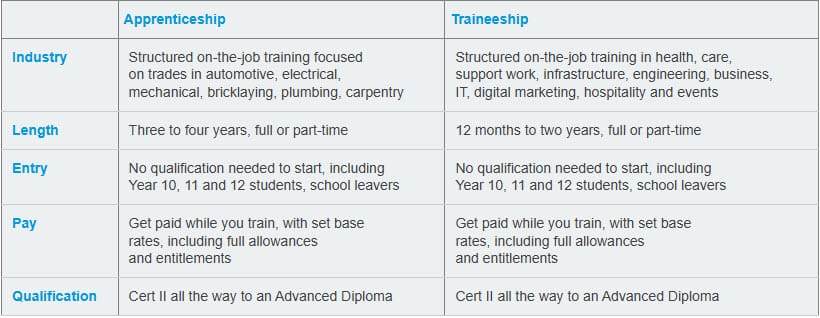
Record-Keeping and Compliance Requirements
Overall, employers are subject to the same record-keeping and compliance requirements as any regular employee when employing new entrants in the workforce.
However, additional requirements and restrictions apply to both Apprentices and Trainees.
Junior Employees
Pay Rates, Allowances, Loadings and Entitlements
With the exception of their reduced rate of pay, Junior employees are treated the same way as adult employees. Junior employees can be employed as full-time, part-time and casual and are entitled to the same allowances, loadings and entitlements as stipulated in the relevant Industrial Instrument.
Apprentices
Pay Rates
Apprentices’ pay rates are included in the relevant Award or Enterprise Agreement. Most Awards include separate rates for School-based, Junior and Adult Apprentices.
Finally, some Awards also include different pay rates for apprentices who attend 3-year versus 4-year apprenticeships.
Allowances
All-Purpose Allowances
Since the implementation of Single Touch Payroll Phase 2, employers are required to report all-purpose allowances separately from the employees’ base rates. This process, called disaggregation of earnings, should be performed separately for regular employees and apprentices, as some of the all-purpose allowances may not be applicable to apprentices.
Travel and Fares Allowances
Many Awards pay a different daily rate for Travel and Fares Allowances to Apprentices. The rate also varies depending on whether the employee is a junior or an adult Apprentice and the Apprenticeship year currently attending.
Loadings and Entitlements
Apprentices are entitled to the same loadings and entitlements as standard employees. However, further restrictions apply to the type of employment basis an apprentice can be employed. In most States and Territories, apprentices can only be employed on either a Full-time or Part-time basis, making the casual loadings entitlements redundant.
Trainees
Pay Rates
For some industry sectors, Trainees’ pay rates can be found on the classified Industry Award. However, most trainees’ pay rates are included in Schedule E of the Miscellaneous Award [MA000104].
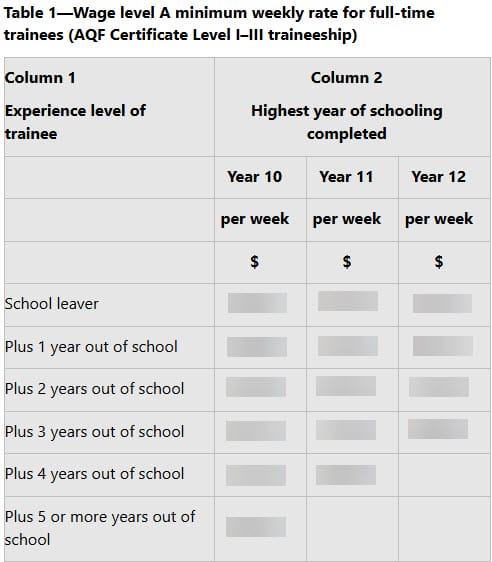
Trainees’ rates, as part of the Miscellaneous Award, are structured across 3 levels (A, B and C), based on the undertaken course.
Within each level, a different pay rate applies for the Highest year of schooling completed, plus the experience level, which is determined by the number of years out of school. These rates are stand-alone, all-purpose allowances do not apply to trainees’ rates.
A sample table of a Trainee Wage Level from Schedule E of the Miscellaneous Award
Allowances, Loadings and Entitlements
All Allowances (except for all-purpose allowances), loadings and entitlements applicable to standard employees, also apply to Trainees.

Impact on Other State & Territory Taxes
Some States and Territories provide tax exemptions for Apprentices and/or Trainees’ wages on other Tax obligations.
Impact on Workers’ Compensation Annual Wages Declaration
Trainees and apprentices are treated differently across each state and territory. See Table below:
Impact of Apprentices wages on the Workers’ Compensation Wages Annual Declaration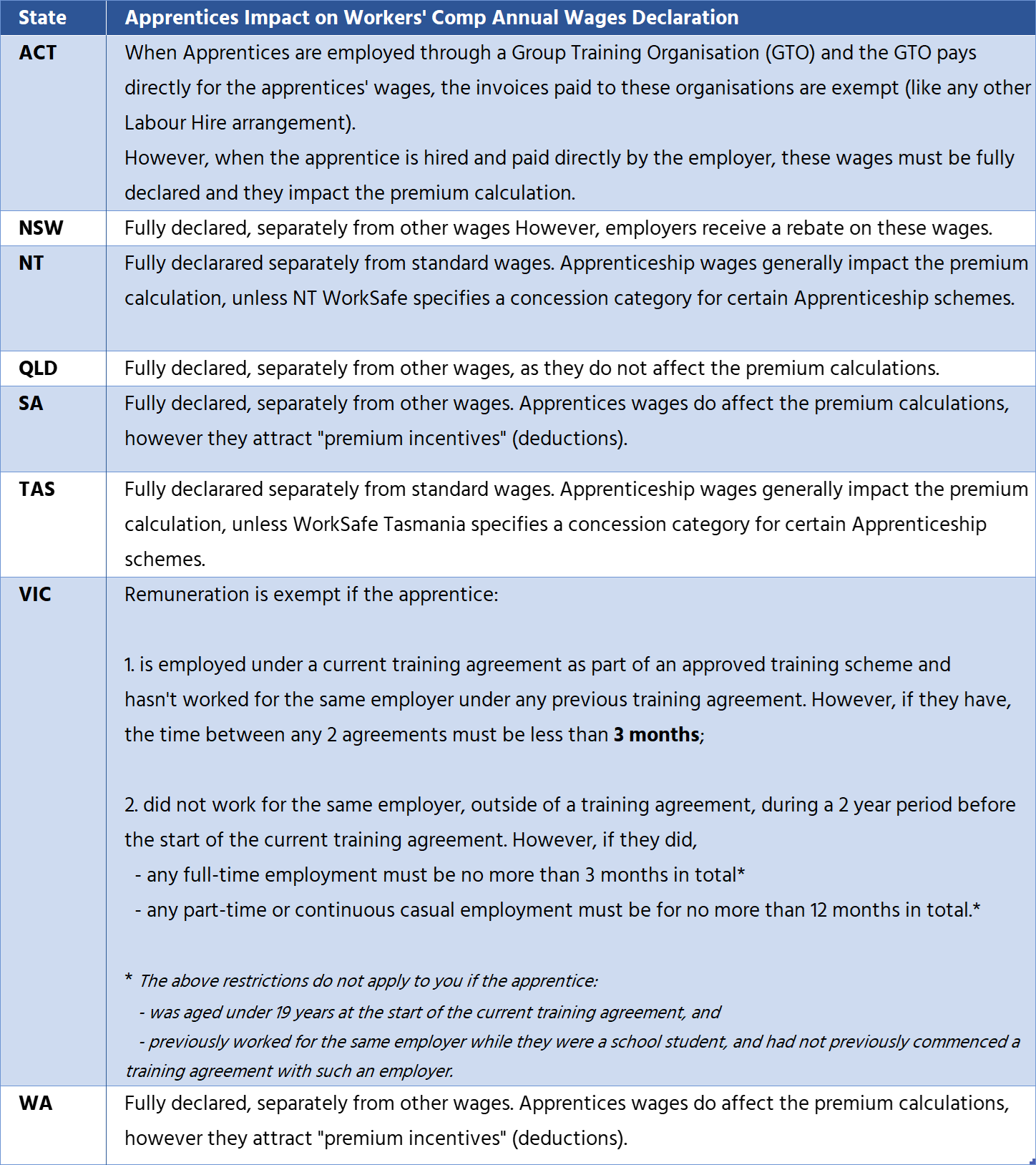
Impact of Trainees wages on the Workers’ Compensation Wages Annual Declaration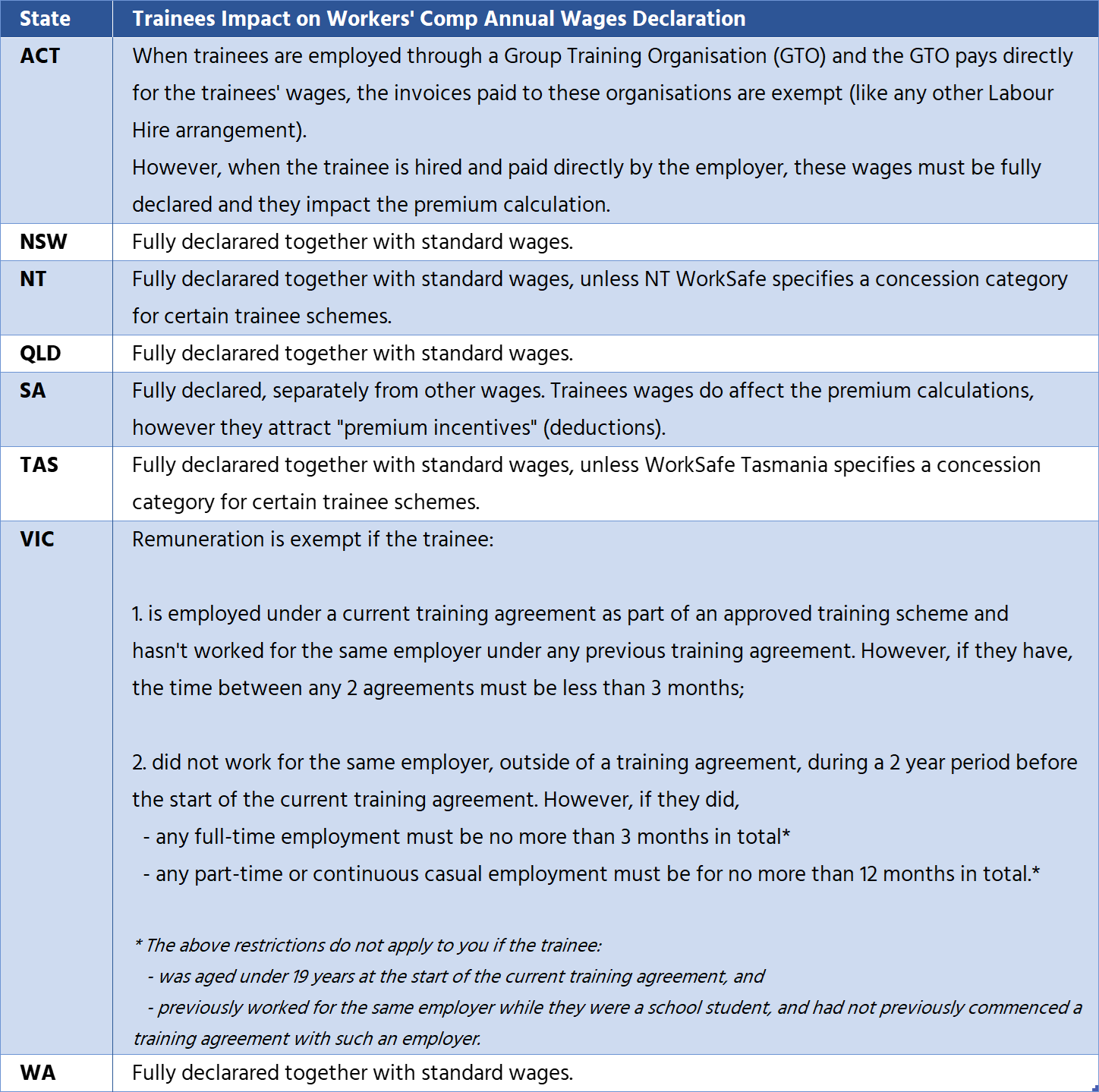
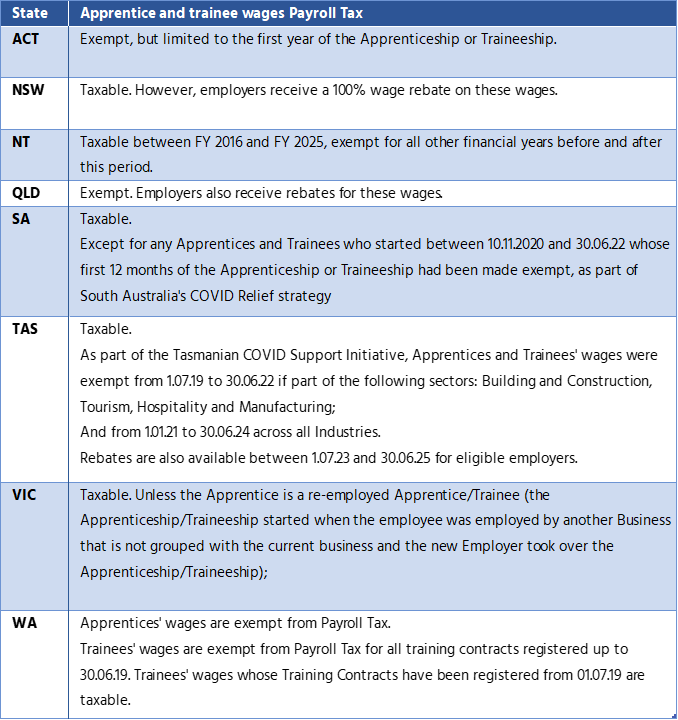
Impact on Payroll Tax
The impact on Apprentices’ and Trainees’ wages on Payroll Tax varies substantially in each State and Territory. See Table below.
Financial Benefits and Costs
Financial Benefits
The Australian Government provides a range of incentives to encourage Australian Businesses to employ Apprentices and Trainees. The range of Financial Benefits includes:
- Reduced Pay Rates
Apprentices’ and Trainees’ hourly rates are generally lower than standard adult rates. However, the hourly rates of these employees may hide additional costs often overlooked by employers; - Priority Hiring Incentive
This incentive is available to employers who hire Apprentices/Trainees undertaking a qualification at Certificate III or above listed on the Apprenticeship Priority List.
Employers eligible for this incentive may be entitled to a total sum of $5,000 for the first year of the Apprentice’s employment, distributed as follows:
– $2,000 at 6 months and a further $3,000 at 12 months (full-time workers);
– $1,000 at 6 months and a further $1,500 at 12 months (part-time workers). - Hiring Incentive
Employers that are not eligible for the Priority Hiring Incentive may still be eligible for the Hiring Incentive. This is a one-off payment made after 6 and 12 months of employing an apprentice of:
– $1,750 for a full-time Apprentice;
– $875 for a part-time Apprentice. - Disability Australian Apprentices Wage Support (DAAWS)
This incentive is available to employers who employ apprentices with a disability.
These employers receive up to $104.30 weekly for either the full Apprenticeship (for employees with permanent disabilities) or the length of the temporary disability.
True Financial Cost
Whilst the financial benefits of hiring Apprentices and Trainees may be obvious, the true cost of these workers is often hidden. Therefore, it is important before employing a high number of apprentices and/or trainees to assess all hidden costs.
- Cost related to Study time
A core requirement for all Apprenticeship is to allow the worker the time to attend the required educational courses to obtain their qualifications. Often this consists of one day per week.
This means when calculating the true cost per hour of that employee on site, the employer should use the following formula:
(pay rate * 38 weekly hours) / 30.4 hours. - Costs to cover study resources
Most Awards also require the employer to cover the cost of the TAFE course fees, books and other resources. - Supervision costs
Apprenticeships and trainees are required to work only under supervision. Their work must be included a mixture of work and training on-site. When employing an Apprentice/Trainee, you should also consider the cost of one of your more experienced employees spent towards providing on-the-job training
Conclusions
When looking at saving labour cost, engaging a younger and less experienced workers can be an effective solution. However, employers should ensure the employment of a younger and inexperienced worker can lead to direct financial benefits (Junior, Apprenticeship or trainee rates) by reviewing the available options as part of their Industry Award and also be mindful of the hidden costs behind the engagement of these workers.
References
https://www.apprenticeshipsupport.com.au/Home
https://www.apprenticeships.gov.au/support-and-resources/financial-support-employers
https://www.apprenticeshipcareers.com.au/?
https://www.apprenticeships.gov.au/
https://www.megt.com.au/incentives
Disclaimer
This blog and attached resources are of general nature designed for informational and educational purposes only. They should not be construed as professional financial advice for your individual business. Should you need such advice, consult a licensed financial or tax advisor.


